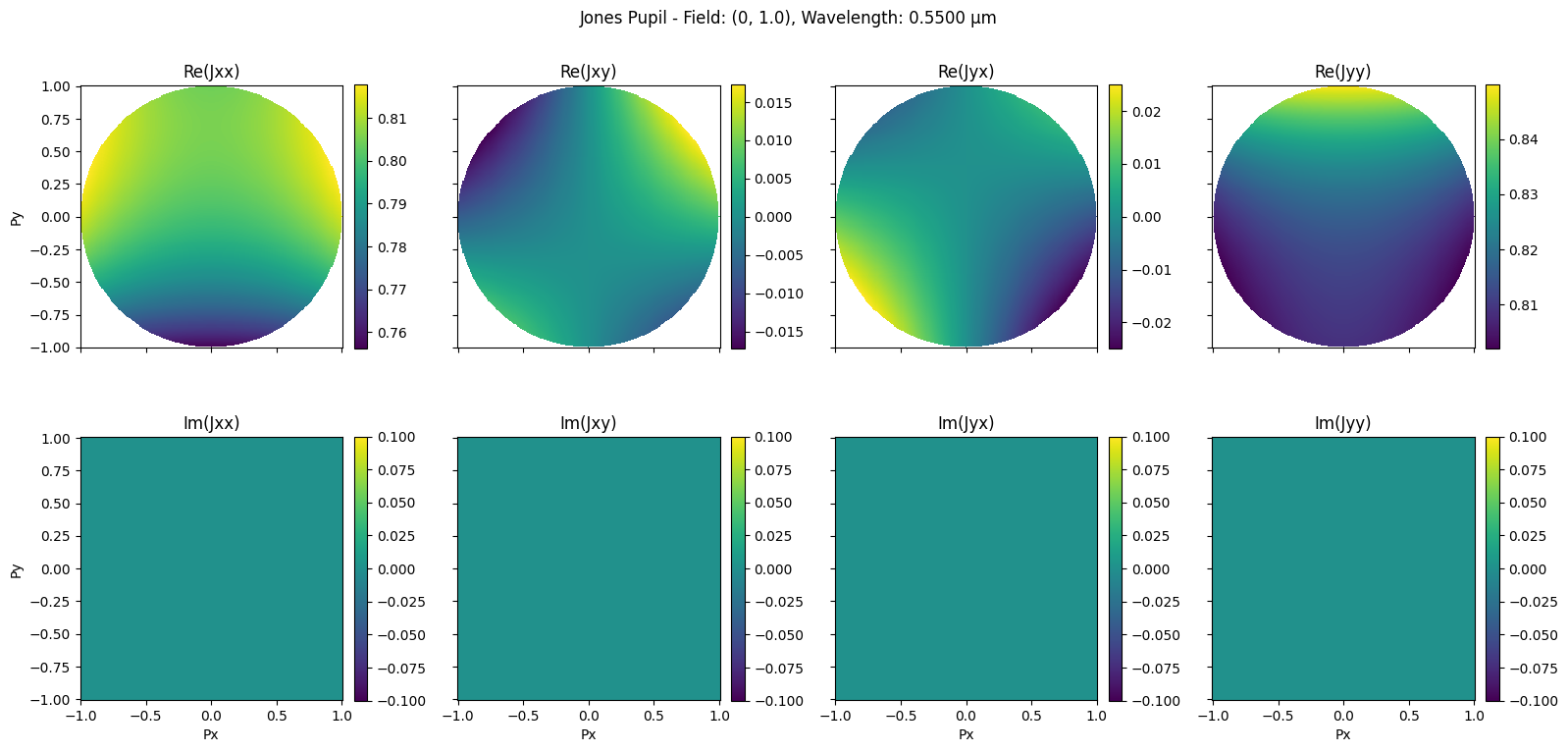
Jones Pupil Analysis
This example demonstrates how to perform a Jones pupil analysis in Optiland. The Jones pupil analysis visualizes the spatially resolved Jones matrix elements across the pupil, providing insight into the polarization properties of the optical system.
[1]:
import matplotlib.pyplot as plt
from optiland.samples.objectives import CookeTriplet
from optiland.analysis import JonesPupil
from optiland.rays import PolarizationState
from optiland.visualization import OpticViewer
1. Setup the Optical System
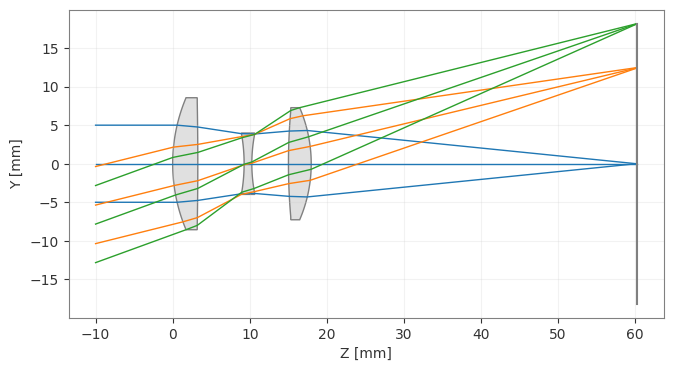
We will use a standard Cooke Triplet for this demonstration.
[9]:
optic = CookeTriplet()

# Set polarization to unpolarized light
state = PolarizationState(is_polarized=False)
optic.updater.set_polarization(state)

# Set Fresnel coatings for all surfaces
optic.surfaces.set_fresnel_coatings()

_ = optic.draw()
2. Basic Jones Pupil Analysis
We instantiate the JonesPupil analysis class with the optic and call the view() method. This generates a grid of plots showing the Real and Imaginary parts of the Jones matrix elements (\(J_{xx}, J_{xy}, J_{yx}, J_{yy}\)) across the pupil.
[10]:
analysis = JonesPupil(optic)
fig, axs = analysis.view()
plt.show()
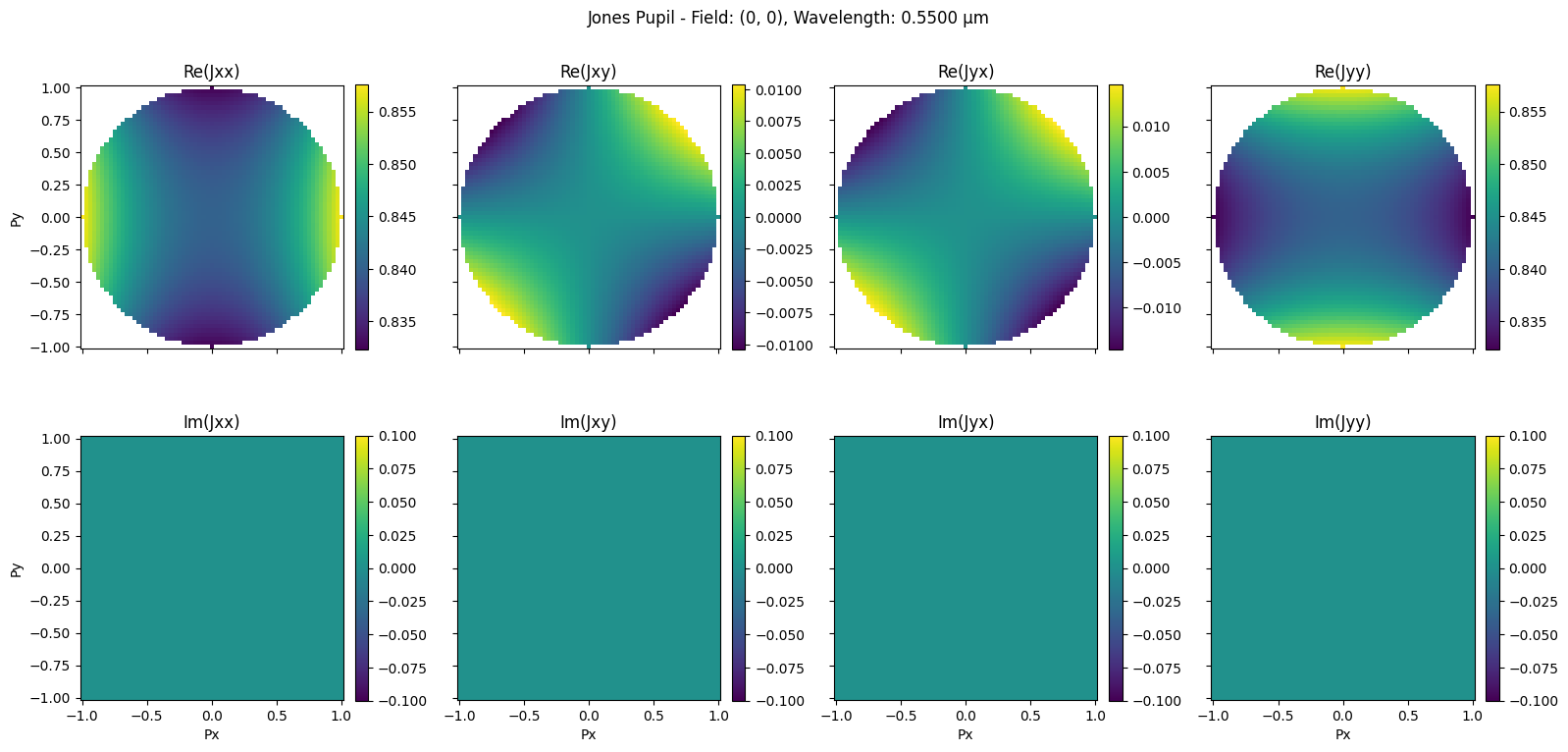
For an on-axis, rotationally symmetric system like the Cooke Triplet, the Jones Pupil reveals geometric polarization aberrations arising from Fresnel effects at curved interfaces.
Diagonal Terms (:math:`J_{xx}, J_{yy}`): These represent the primary transmission (\(\approx 0.85\)) but display a saddle-like magnitude. This occurs because the transmission for parallel-polarized light (\(T_p\)) is generally higher than for perpendicular-polarized light (\(T_s\)).
:math:`J_{xx}`: Maximized along the X-axis (where light is \(p\)-polarized) and minimized along the Y-axis (where light is \(s\)-polarized).
:math:`J_{yy}`: Rotated by \(90^\circ\) relative to \(J_{xx}\) (Maximized on Y, minimized on X).
Off-Diagonal Terms (:math:`J_{xy}, J_{yx}`): These terms represent polarization crosstalk (leakage). They form a characteristic “Maltese Cross” pattern, where leakage is zero along the cardinal axes (\(X, Y\)) and maximizes at the \(\pm 45^\circ\) diagonals due to the geometric rotation of the plane of incidence.
3. Customizing the Analysis
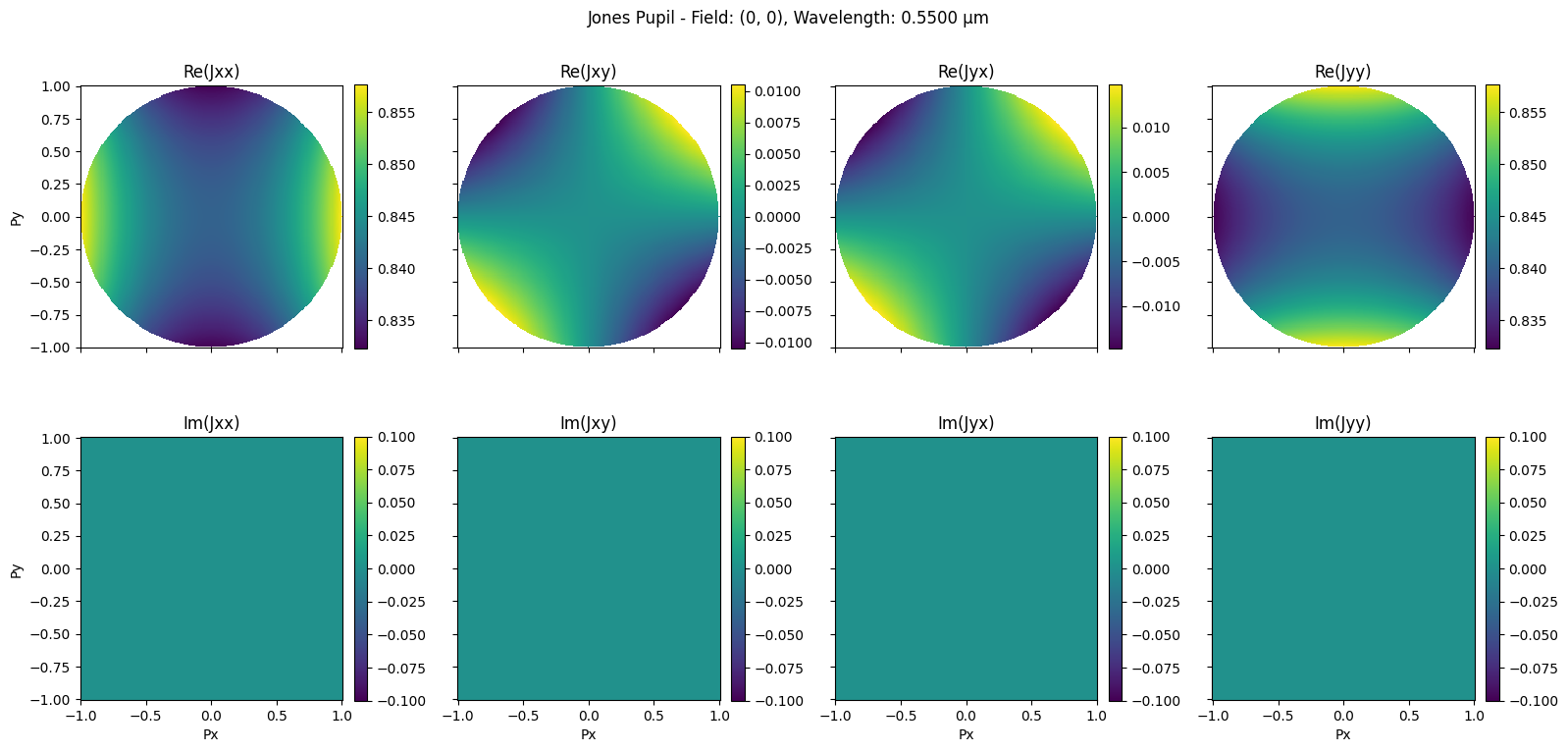
We can customize the analysis by specifying fields, wavelengths, and the grid size.
[4]:
# Analyze at a specific wavelength and higher resolution
analysis_custom = JonesPupil(optic, wavelengths=[0.55], grid_size=257)
fig, axs = analysis_custom.view()
plt.show()
4. Off-Axis Field
Let’s look at an off-axis field point. We first add a field to the optic if it doesn’t exist, or pass it explicitly.
[5]:
# Passing specific field coordinates (Hx, Hy)
analysis_off_axis = JonesPupil(optic, field=(0, 1.0), grid_size=257)
fig, axs = analysis_off_axis.view()
plt.show()