Orthogonal Descent Optimization
[1]:
import numpy as np

from optiland import optic, optimization
Define a starting lens:
[2]:
lens = optic.Optic()

# add surfaces
lens.surfaces.add(index=0, thickness=np.inf)
lens.surfaces.add(index=1, thickness=7, radius=1000, material="N-SF11", is_stop=True)
lens.surfaces.add(index=2, thickness=30, radius=-1000)
lens.surfaces.add(index=3)

# set aperture
lens.set_aperture(aperture_type="EPD", value=15)

# add field
lens.fields.set_type(field_type="angle")
lens.fields.add(y=0)

# add wavelength
lens.wavelengths.add(value=0.55, is_primary=True)

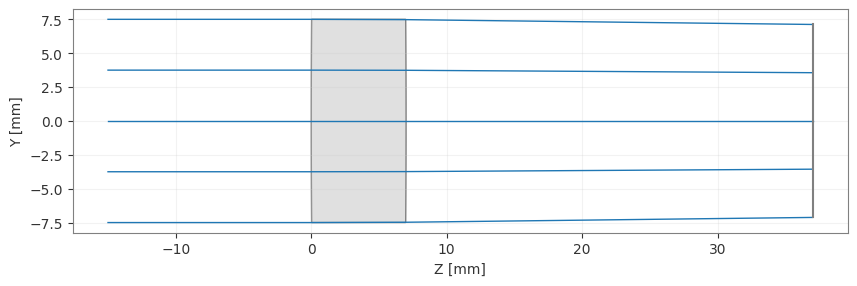
# draw lens
_ = lens.draw(num_rays=5)
Define optimization problem:
[3]:
problem = optimization.OptimizationProblem()
Add operands (targets for optimization):
[4]:
"""
Define RMS spot size properties for the optimization:
    1. Surface number = -1, implying last surface (image surface)
    2. Normalized field coordinates (Hx, Hy) = (0, 0)
    3. Number of rays = 5, corresponds to number of rings in hexapolar distribution
        (see distribution documentation)
    4. Wavelength = 0.55 µm
    5. Pupil distribution = hexapolar
"""

input_data = {
    "optic": lens,
    "surface_number": -1,
    "Hx": 0,
    "Hy": 0,
    "num_rays": 5,
    "wavelength": 0.55,
    "distribution": "hexapolar",
}

# add RMS spot size operand
problem.add_operand(
    operand_type="rms_spot_size",
    target=0,
    weight=1,
    input_data=input_data,
)
Define variables - let radius of curvature vary for both surfaces, at surface index 1 and 2:
[5]:
problem.add_variable(lens, "radius", surface_number=1)
problem.add_variable(lens, "radius", surface_number=2)
Check initial merit function value and system properties:
[6]:
problem.info()
╒════╤════════════════════════╤═══════════════════╕
│    │   Merit Function Value │   Improvement (%) │
╞════╪════════════════════════╪═══════════════════╡
│  0 │                30.0924 │                 0 │
╘════╧════════════════════════╧═══════════════════╛
╒════╤════════════════╤══════════╤══════════════╤══════════════╤══════════╤═════════╤═════════╤════════════════╕
│    │ Operand Type   │   Target │ Min. Bound   │ Max. Bound   │   Weight │   Value │   Delta │   Contrib. [%] │
╞════╪════════════════╪══════════╪══════════════╪══════════════╪══════════╪═════════╪═════════╪════════════════╡
│  0 │ rms spot size  │        0 │              │              │        1 │   5.486 │   5.486 │            100 │
╘════╧════════════════╧══════════╧══════════════╧══════════════╧══════════╧═════════╧═════════╧════════════════╛
╒════╤═════════════════╤═══════════╤═════════╤══════════════╤══════════════╕
│    │ Variable Type   │   Surface │   Value │ Min. Bound   │ Max. Bound   │
╞════╪═════════════════╪═══════════╪═════════╪══════════════╪══════════════╡
│  0 │ radius          │         1 │    1000 │              │              │
│  1 │ radius          │         2 │   -1000 │              │              │
╘════╧═════════════════╧═══════════╧═════════╧══════════════╧══════════════╛
Define optimizer (Orthogonal Descent):
[7]:
optimizer = optimization.OrthogonalDescent(problem)
Run optimization:
[8]:
optimizer.optimize(max_iter=100, tol=1e-3)
Print merit function value and system properties after optimization:
[9]:
problem.info()
╒════╤════════════════════════╤═══════════════════╕
│    │   Merit Function Value │   Improvement (%) │
╞════╪════════════════════════╪═══════════════════╡
│  0 │             0.00188088 │           99.9657 │
╘════╧════════════════════════╧═══════════════════╛
╒════╤════════════════╤══════════╤══════════════╤══════════════╤══════════╤═════════╤═════════╤════════════════╕
│    │ Operand Type   │   Target │ Min. Bound   │ Max. Bound   │   Weight │   Value │   Delta │   Contrib. [%] │
╞════╪════════════════╪══════════╪══════════════╪══════════════╪══════════╪═════════╪═════════╪════════════════╡
│  0 │ rms spot size  │        0 │              │              │        1 │   0.043 │   0.043 │            100 │
╘════╧════════════════╧══════════╧══════════════╧══════════════╧══════════╧═════════╧═════════╧════════════════╛
╒════╤═════════════════╤═══════════╤════════════╤══════════════╤══════════════╕
│    │ Variable Type   │   Surface │      Value │ Min. Bound   │ Max. Bound   │
╞════╪═════════════════╪═══════════╪════════════╪══════════════╪══════════════╡
│  0 │ radius          │         1 │    28.0266 │              │              │
│  1 │ radius          │         2 │ -1000      │              │              │
╘════╧═════════════════╧═══════════╧════════════╧══════════════╧══════════════╛
Draw final lens:
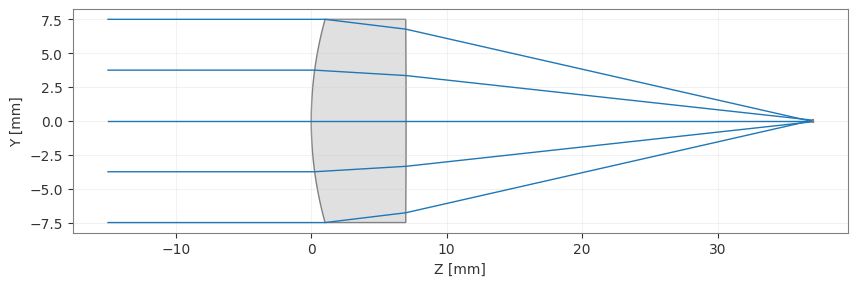
[10]:
_ = lens.draw(num_rays=5)