Tutorial 5d: Advanced Thin Film Applications
Consolidating color performance metrics, anti-reflective (AR) coating system design, and thin-film tolerance simulation.
[1]:
import matplotlib.pyplot as plt
import optiland.backend as be
from optiland.materials import IdealMaterial, Material
from optiland.thin_film import SpectralAnalyzer, ThinFilmStack
from optiland.colorimetry.plotting import plot_cie_1931_chromaticity_diagram
1) Define the stack and wavelength grid
We use air as the incident medium, a TiO2 layer with variable thickness, and a silica (SiO2) substrate. The spectrum is sampled from 380 to 780 nm with a 5 nm step.
[2]:
air = IdealMaterial(n=1.0)
sio2 = Material("SiO2", reference="Gao")
tio2 = Material("TiO2", reference="Zhukovsky")

stack = ThinFilmStack(incident_material=air, substrate_material=sio2)
stack.add_layer_nm(tio2, 0.0, name="TiO2")

analyzer = SpectralAnalyzer(stack)

max_thickness_nm = 250.0
wavelengths_nm = be.linspace(380.0, 780.0, 81)
thicknesses_nm = be.linspace(0.0, max_thickness_nm, 251)
2) Compute chromaticity for each thickness
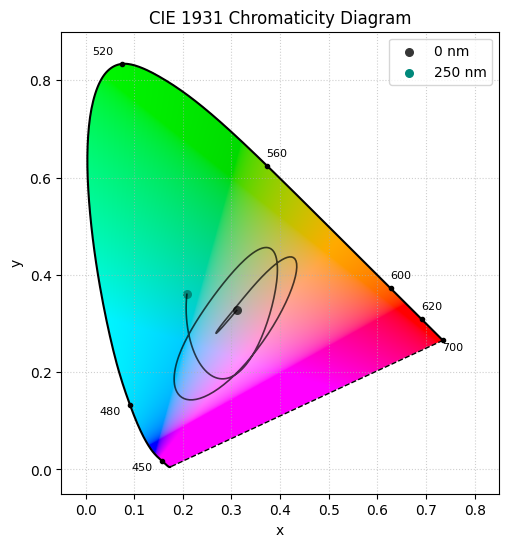
We compute the reflected spectrum for each thickness, then extract CIE \(x,y\) and an sRGB triplet for visualization. The spectrum is a normalized power quantity (R), which is sufficient for chromaticity.
[3]:
x_path = []
y_path = []
colors = []

for thickness_nm in thicknesses_nm:
    stack.layers[0].thickness_um = float(thickness_nm) / 1000.0

    result = analyzer.analyze_color(
        wavelength_values=wavelengths_nm,
        wavelength_unit="nm",
        aoi=0.0,
        aoi_unit="deg",
        polarization="u",
        quantity="R",
        observer="2deg",
    )

    x, y, _ = result["xyY"]
    r, g, b = result["sRGB"]

    x_path.append(x)
    y_path.append(y)
    colors.append([r / 255.0, g / 255.0, b / 255.0])
3) Plot the chromaticity path on the CIE 1931 diagram
We plot the path and mark the start (0 nm) and end (250 nm) points.
[4]:
fig, ax = plot_cie_1931_chromaticity_diagram(color="fill")

ax.plot(x_path, y_path, color="black", linewidth=1.2, alpha=0.7)
ax.scatter(x_path[0], y_path[0], s=30, color=colors[0], label="0 nm")
ax.scatter(x_path[-1], y_path[-1], s=30, color=colors[-1], label="250 nm")
ax.legend()

plt.show()
4) Color bar versus thickness
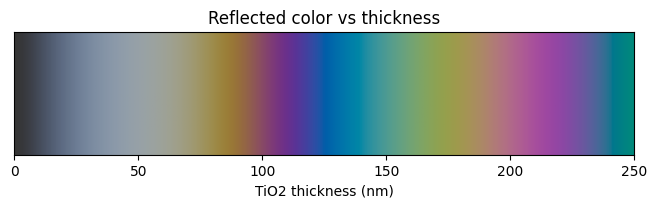
This compact color bar summarizes the perceived reflected color as a function of TiO_2 thickness. We obtain the Michel-Levy chart.
[5]:
colors_array = be.asarray(colors)
colors_image = colors_array[None, :, :]

fig, ax = plt.subplots(figsize=(8, 1.6))
ax.imshow(
    colors_image,
    aspect="auto",
    extent=[float(thicknesses_nm[0]), float(thicknesses_nm[-1]), 0, 1],
)
ax.set_yticks([])
ax.set_xlabel("TiO2 thickness (nm)")
ax.set_title("Reflected color vs thickness")

plt.show()
Part 2: Ar Coating System
Introduction
Uncoated glass reflects about 4% of incident light per surface due to the refractive index mismatch between air (\(n \approx 1\)) and glass (\(n \approx 1.5\)). In multi-element optical systems, these losses accumulate and cause ghost images.
This tutorial demonstrates: 1. Baseline Analysis: The reflection of a bare glass surface (Fresnel reflection). 2. BBAR Design: Creating a 4-layer Anti-Reflective coating using \(MgF_2\) and \(TiO_2\). 3. Performance Comparison: Visually and numerically comparing the coated vs. uncoated surface. 4. Angular Stability: Evaluating performance at oblique angles of incidence (\(0^\circ, 30^\circ, 60^\circ\)).
[5]:
import numpy as np
import matplotlib.pyplot as plt
from optiland import optic
from optiland.materials import Material, IdealMaterial
from optiland.thin_film import ThinFilmStack
from optiland.coatings import ThinFilmCoating, FresnelCoating
1. Materials & Baseline Setup
We define the materials and the reference wavelength (\(\lambda = 550\) nm).
[6]:
# Define Materials
air = IdealMaterial(n=1.0)
glass = Material("N-BK7", reference="SCHOTT")
mgf2 = Material("MgF2", reference="Li")    # Low Index (~1.38)
tio2 = Material("TiO2", reference="Siefke") # High Index (~2.5)

# Setup wavelength range (Visible Spectrum)
wavelengths = np.linspace(0.45, 0.7, 301) # 450-700 nm in µm

# Baseline: Uncoated Glass (Fresnel Reflection)
# We use FresnelCoating to simulate the bare interface
bare_surface = FresnelCoating(air, glass)
2. Design the BBAR Stack
We implement a 4-layer BBAR design (LHLH structure). Crucially, the first layer facing air must be the Low Index material to avoid large reflections.
Stack Recipe (Air :math:`rightarrow` Glass): 1. MgF2 (94 nm) - Low Index (Outer Layer) 2. TiO2 (117 nm) - High Index 3. MgF2 (38 nm) - Low Index (Thin) 4. TiO2 (14 nm) - High Index (Inner Matching Layer)
This structure is optimized to suppress reflection across the visible spectrum (400-700nm).
[7]:
# Create the Stack
bbar_stack = ThinFilmStack(incident_material=air, substrate_material=glass)

# Add layers (incident -> substrate)
# Start with Low Index (MgF2) facing Air to minimize first surface reflection.
# Thicknesses (um): ~94nm, ~117nm, ~38nm, ~14nm
# This is an optimized structure for 400-700nm.
bbar_stack.add_layer(mgf2, 0.094, "L1 (Outer)")
bbar_stack.add_layer(tio2, 0.117, "H1")
bbar_stack.add_layer(mgf2, 0.038, "L2")
bbar_stack.add_layer(tio2, 0.014, "H2 (Inner)")

# Create the Coating Object
bbar_coating = ThinFilmCoating(air, glass, bbar_stack)

# Inspect the design
print(bbar_stack)
ThinFilmStack Summary
---------------------
Incident:  IdealMaterial
Substrate: N-BK7
Layers:
  1. MgF2 (94.0 nm)
  2. TiO2 (117.0 nm)
  3. MgF2 (38.0 nm)
  4. TiO2 (14.0 nm)
---------------------
Total Thickness: 263.0 nm
3. Spectral Performance Analysis
We compare the Reflectance (\(R\)) of the BBAR coating against the bare glass baseline at normal incidence (\(0^\circ\)).
[8]:
# Compute Reflectance for BBAR
R_bbar = bbar_stack.compute_rtRTA(wavelengths, aoi_rad=0.0, polarization="u")["R"]

# Compute Reflectance for Bare Glass
# We calculate theoretical Fresnel reflection for comparison
n_glass = glass.n(wavelengths)
R_glass = ((1.0 - n_glass) / (1.0 + n_glass))**2

# Visualization
plt.figure(figsize=(10, 6))
plt.plot(wavelengths * 1000, R_glass * 100, 'k--', linewidth=1.5, label="Bare Glass (~4.2%)")
plt.plot(wavelengths * 1000, R_bbar * 100, 'b-', linewidth=2.5, label="4-Layer BBAR")

plt.title("Broadband AR Coating Performance")
plt.xlabel("Wavelength (nm)")
plt.ylabel("Reflectance (%)")
plt.grid(True, alpha=0.3)
plt.legend()
plt.ylim(0, 5)
plt.show()

avg_R_bbar = np.mean(R_bbar) * 100
print(f"Average Reflectance (400-700nm): {avg_R_bbar:.2f}%")
WARNING: No extinction coefficient data found for Li-o.yml. Assuming it is 0.
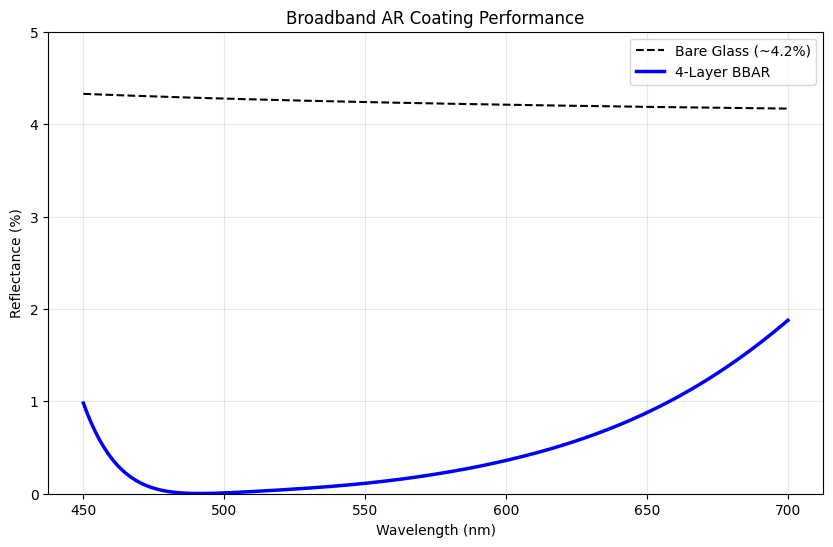
Average Reflectance (400-700nm): 0.48%
4. System Transmission Comparison: BBAR vs Fresnel
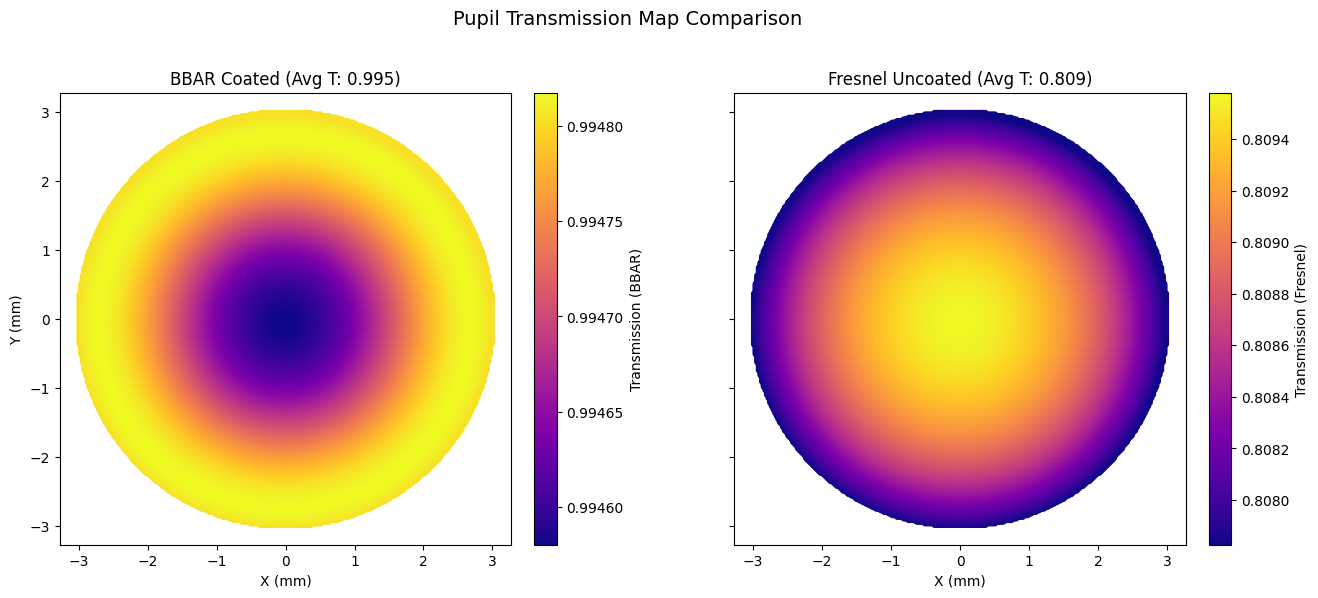
In this section, we compare the total transmission of the lens system coated with our custom BBAR stack versus a standard Fresnel (uncoated) system. We will visualize the pupil transmission map for both cases.
[9]:
from optiland.rays import PolarizationState

class CoatedDoublet(optic.Optic):
    def __init__(self, coating=None):
        super().__init__()

        self.surfaces.add(index=0, radius=np.inf, thickness=np.inf)
        self.surfaces.add(
            index=1,
            radius=29.32908,
            thickness=0.7,
            material="N-BK7",
            is_stop=True,
            coating=coating,
        )
        self.surfaces.add(index=2, radius=-20.06842, thickness=0.032, coating=coating)
        self.surfaces.add(
            index=3,
            radius=-20.08770,
            thickness=0.5780,
            material=("SF2", "schott"),
            coating=coating,
        )
        self.surfaces.add(index=4, radius=-66.54774, thickness=47.3562, coating=coating)
        self.surfaces.add(index=5)

        self.set_aperture(aperture_type="imageFNO", value=8.0)

        self.fields.set_type(field_type="angle")
        self.fields.add(y=0.0)
        self.fields.add(y=0.7)
        self.fields.add(y=1.0)

        self.wavelengths.add(value=0.4861)
        self.wavelengths.add(value=0.5876, is_primary=True)
        self.wavelengths.add(value=0.6563)

        self.update_paraxial()
        self.image_solve()

        # Set Polarization (Required for ThinFilmCoating)
        state = PolarizationState(is_polarized=False)
        self.set_polarization(state)

# 1. System with BBAR Coating
lens_bbar = CoatedDoublet(coating=bbar_coating)
rays_bbar = lens_bbar.trace(Hx=0, Hy=0, wavelength=0.55, num_rays=256, distribution="uniform")
intensity_bbar = rays_bbar.i

# 2. System with Standard Fresnel Surface (Air/Glass Refraction)
# We use a FresnelCoating to simulate the standard reflection loss at each interface (~4%)
fresnel_coating = FresnelCoating(air, glass)
lens_fresnel = CoatedDoublet(coating=fresnel_coating)
rays_fresnel = lens_fresnel.trace(Hx=0, Hy=0, wavelength=0.55, num_rays=256, distribution="uniform")
intensity_fresnel = rays_fresnel.i

print(f"Average Transmission (BBAR Coated): {np.mean(intensity_bbar):.4f}")
print(f"Average Transmission (Fresnel Uncoated): {np.mean(intensity_fresnel):.4f}")
print(f"Improvement: {(np.mean(intensity_bbar) - np.mean(intensity_fresnel)) / np.mean(intensity_fresnel) * 100:.1f}%")
Average Transmission (BBAR Coated): 0.9948
Average Transmission (Fresnel Uncoated): 0.8087
Improvement: 23.0%
[14]:
# Get pupil coordinates (Stop is at surface 1)
x_stop_bbar = lens_bbar.surfaces.x[1, :]
y_stop_bbar = lens_bbar.surfaces.y[1, :]

x_stop_fresnel = lens_fresnel.surfaces.x[1, :]
y_stop_fresnel = lens_fresnel.surfaces.y[1, :]

# Comparative visualization
fig, axes = plt.subplots(1, 2, figsize=(14, 6), sharex=True, sharey=True)

# Plot BBAR coated (own scale + own colorbar)
sc1 = axes[0].scatter(
    x_stop_bbar,
    y_stop_bbar,
    c=intensity_bbar,
    s=20,
    cmap="plasma",
    vmin=np.min(intensity_bbar),
    vmax=np.max(intensity_bbar),
)
axes[0].set_title(f"BBAR Coated (Avg T: {np.mean(intensity_bbar):.3f})")
axes[0].set_aspect("equal", adjustable="box")
axes[0].set_xlabel("X (mm)")
axes[0].set_ylabel("Y (mm)")
cbar1 = fig.colorbar(sc1, ax=axes[0], orientation="vertical", fraction=0.046, pad=0.04)
cbar1.set_label("Transmission (BBAR)")

# Plot Fresnel uncoated (own scale + own colorbar)
sc2 = axes[1].scatter(
    x_stop_fresnel,
    y_stop_fresnel,
    c=intensity_fresnel,
    s=20,
    cmap="plasma",
    vmin=np.min(intensity_fresnel),
    vmax=np.max(intensity_fresnel),
)
axes[1].set_title(f"Fresnel Uncoated (Avg T: {np.mean(intensity_fresnel):.3f})")
axes[1].set_aspect("equal", adjustable="box")
axes[1].set_xlabel("X (mm)")
cbar2 = fig.colorbar(sc2, ax=axes[1], orientation="vertical", fraction=0.046, pad=0.04)
cbar2.set_label("Transmission (Fresnel)")

plt.suptitle("Pupil Transmission Map Comparison", fontsize=14)
plt.tight_layout(rect=[0, 0, 1, 0.95])
plt.show()
Part 3: Thin Film Tolerance Analysis
[1]:
import numpy as np
import matplotlib.pyplot as plt
from optiland.materials import Material, IdealMaterial
from optiland.thin_film import ThinFilmStack
from optiland.thin_film.optimization.operand.thin_film import ThinFilmOperand
from optiland.thin_film.tolerancing import (
    ThinFilmTolerancing,
    ThinFilmSensitivityAnalysis,
    ThinFilmMonteCarlo,
)
from optiland.tolerancing.perturbation import RangeSampler, DistributionSampler
1. Nominal design: 7-layer broadband AR on N-BK7
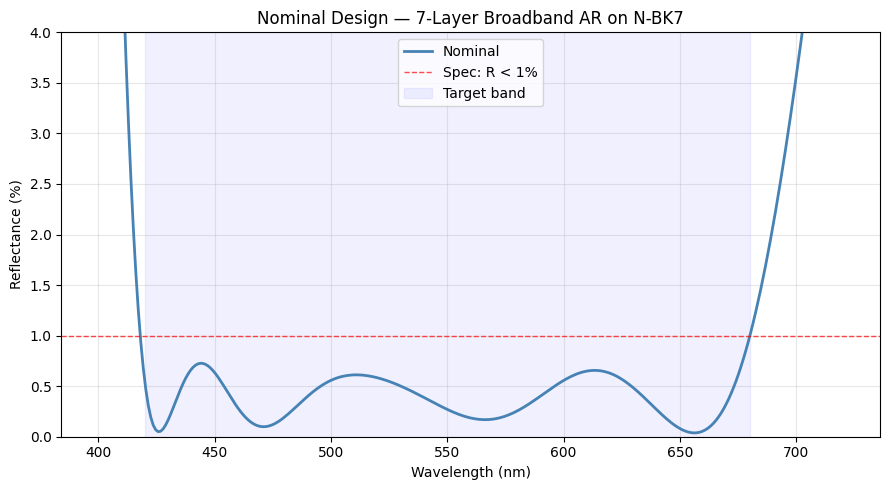
This is the optimized design from Tutorial 6h (needle synthesis). It uses alternating MgF2/Al2O3 layers to achieve R < 1% across 420–680 nm.
[2]:
air = IdealMaterial(n=1.0)
nbk7 = Material("N-BK7")
mgf2 = Material("MgF2", reference="Dodge-o")
al2o3 = Material("Al2O3", reference="Malitson")

# 7-layer design from needle synthesis (Tutorial 6h)
stack = ThinFilmStack(incident_material=air, substrate_material=nbk7)
stack.add_layer_nm(mgf2, 94.6, name="MgF2")
stack.add_layer_nm(al2o3, 319.7, name="Al2O3")
stack.add_layer_nm(mgf2, 17.7, name="MgF2")
stack.add_layer_nm(al2o3, 196.1, name="Al2O3")
stack.add_layer_nm(mgf2, 26.3, name="MgF2")
stack.add_layer_nm(al2o3, 170.9, name="Al2O3")
stack.add_layer_nm(mgf2, 190.4, name="MgF2")
print(stack)
ThinFilmStack Summary
---------------------
Incident:  IdealMaterial
Substrate: N-BK7
Layers:
  1. MgF2 (94.6 nm)
  2. Al2O3 (319.7 nm)
  3. MgF2 (17.7 nm)
  4. Al2O3 (196.1 nm)
  5. MgF2 (26.3 nm)
  6. Al2O3 (170.9 nm)
  7. MgF2 (190.4 nm)
---------------------
Total Thickness: 1015.7 nm
[3]:
wl_plot = np.linspace(400, 720, 300)
R_nominal = np.array([ThinFilmOperand.reflectance(stack, wl) for wl in wl_plot])

fig, ax = plt.subplots(figsize=(9, 5))
ax.plot(wl_plot, R_nominal * 100, "-", color="steelblue", linewidth=2, label="Nominal")
ax.axhline(1.0, color="red", linestyle="--", linewidth=1, alpha=0.7, label="Spec: R < 1%")
ax.axvspan(420, 680, alpha=0.06, color="blue", label="Target band")
ax.set_xlabel("Wavelength (nm)")
ax.set_ylabel("Reflectance (%)")
ax.set_title("Nominal Design — 7-Layer Broadband AR on N-BK7")
ax.set_ylim(0, 4)
ax.legend()
ax.grid(True, alpha=0.3)
fig.tight_layout();
WARNING: No extinction coefficient data found for Dodge-o.yml. Assuming it is 0.
WARNING: No extinction coefficient data found for Malitson-o.yml. Assuming it is 0.
2. Sensitivity Analysis
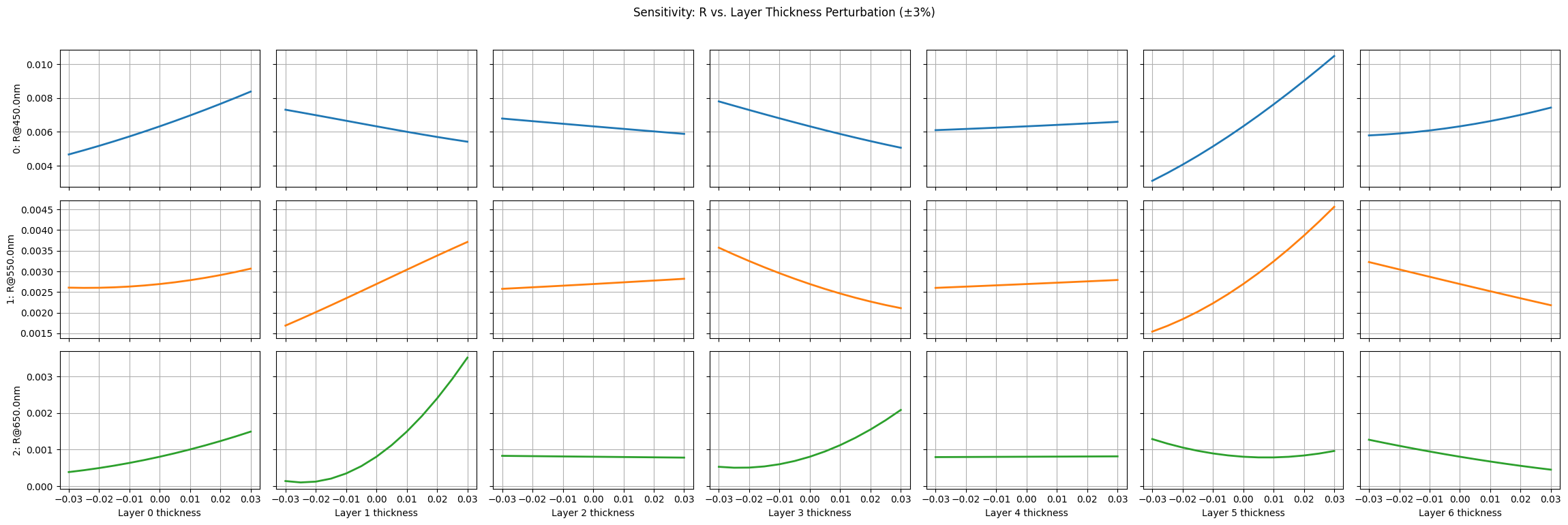
We perturb each layer thickness individually by ±3% (typical for ion-beam sputtering) and observe how reflectance at blue (450 nm), green (550 nm), and red (650 nm) responds. This reveals which of the 7 layers are most critical to control.
[4]:
tol = ThinFilmTolerancing(stack)

# Operands: reflectance at three key wavelengths
tol.add_operand("R", 450.0)
tol.add_operand("R", 550.0)
tol.add_operand("R", 650.0)

# ±3% thickness perturbation on each of the 7 layers
for i in range(7):
    tol.add_perturbation(i, "thickness", RangeSampler(-0.03, 0.03, 13))

sa = ThinFilmSensitivityAnalysis(tol)
sa.run()

fig, axes = sa.view()
fig.suptitle("Sensitivity: R vs. Layer Thickness Perturbation (±3%)", y=1.02)
fig.tight_layout();
[5]:
# Identify which layers have the steepest sensitivity slopes
df_sa = sa.get_results()
operand_cols = [c for c in df_sa.columns if c.startswith("0:") or c.startswith("1:") or c.startswith("2:")]

print("Sensitivity range (max - min reflectance) per layer:")
for ptype in df_sa["perturbation_type"].unique():
    mask = df_sa["perturbation_type"] == ptype
    ranges = df_sa.loc[mask, operand_cols].max() - df_sa.loc[mask, operand_cols].min()
    worst = ranges.max()
    print(f"  {ptype}: max ΔR = {worst*100:.3f}%")
Sensitivity range (max - min reflectance) per layer:
  Layer 0 thickness: max ΔR = 0.371%
  Layer 1 thickness: max ΔR = 0.341%
  Layer 2 thickness: max ΔR = 0.091%
  Layer 3 thickness: max ΔR = 0.274%
  Layer 4 thickness: max ΔR = 0.049%
  Layer 5 thickness: max ΔR = 0.737%
  Layer 6 thickness: max ΔR = 0.164%
3. Monte Carlo Analysis
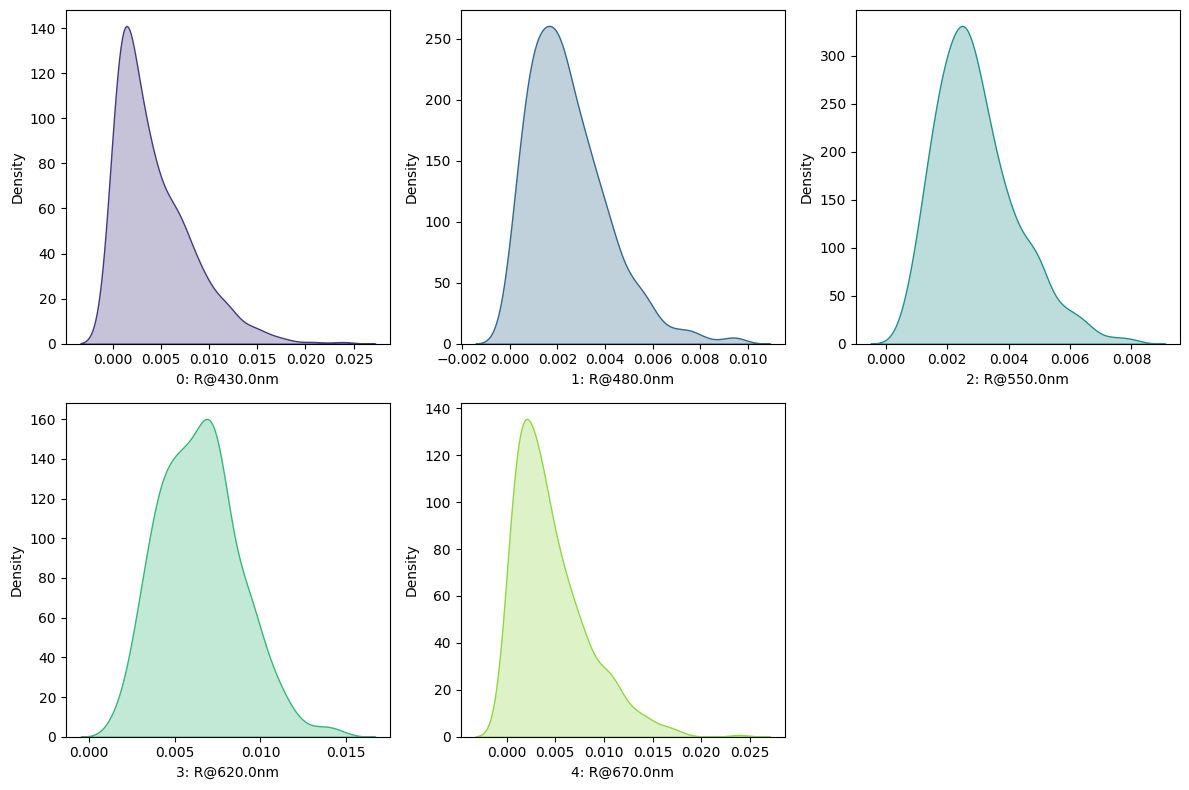
We apply normally-distributed thickness errors (2% std, relative) to all 7 layers simultaneously over 500 trials. This models realistic sputtering variability.
[6]:
tol_mc = ThinFilmTolerancing(stack)

# Operands: reflectance at 5 wavelengths across the band
for wl in [430.0, 480.0, 550.0, 620.0, 670.0]:
    tol_mc.add_operand("R", wl)

# 2% std thickness perturbation on all 7 layers
for i in range(7):
    tol_mc.add_perturbation(
        i, "thickness",
        DistributionSampler("normal", seed=100 + i, loc=0.0, scale=0.02),
    )

mc = ThinFilmMonteCarlo(tol_mc)
mc.run(num_iterations=500)
print(f"Monte Carlo complete: {len(mc.get_results())} trials")
Monte Carlo complete: 500 trials
3a. Reflectance distributions at key wavelengths
[7]:
fig, axes = mc.view_histogram(kde=True)
3b. Cumulative distribution — yield analysis
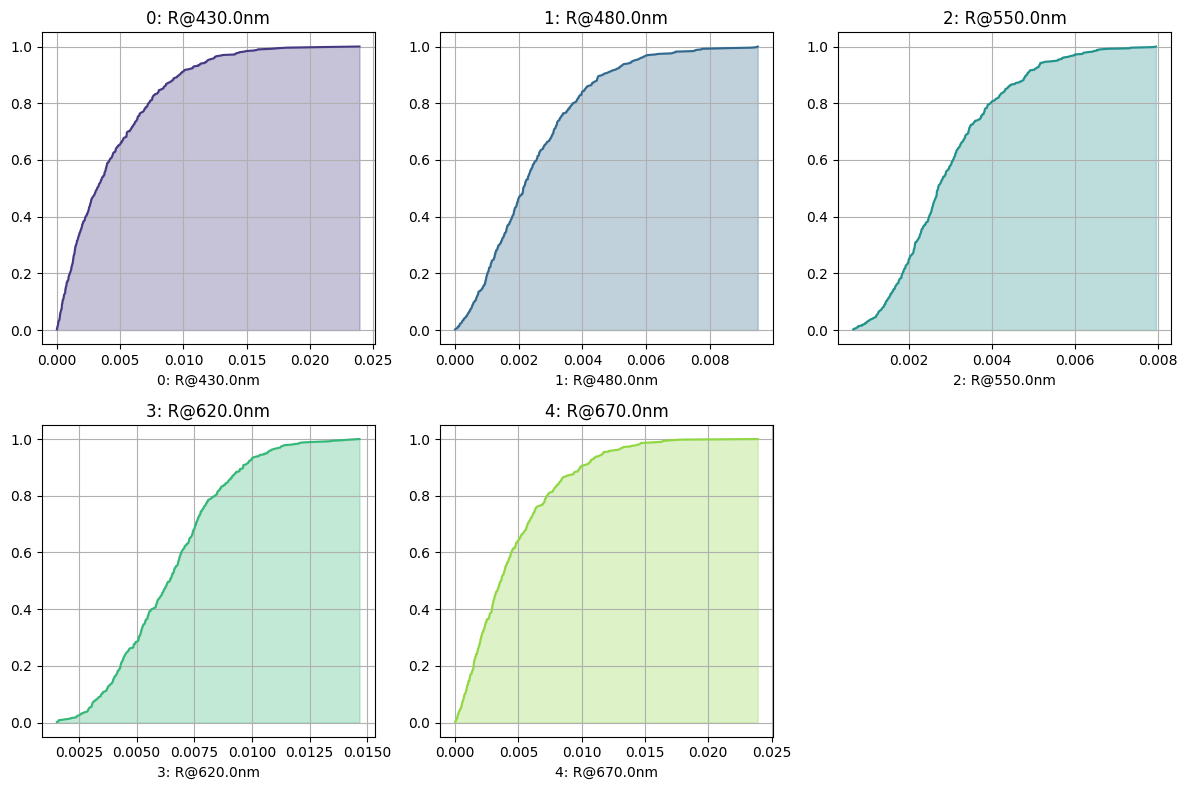
Read off yield from the CDF: e.g., what fraction of parts will have R < 1% at each wavelength?
[8]:
fig, axes = mc.view_cdf()
3c. Spectral tolerance band
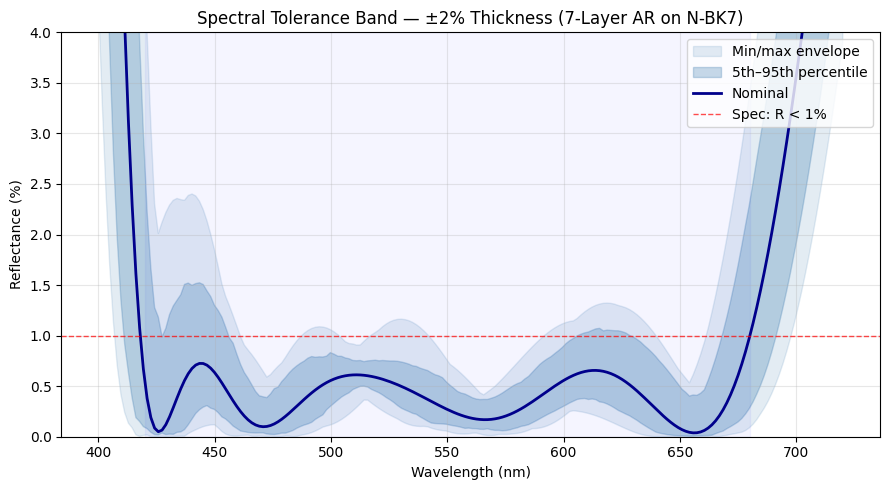
This is the most informative plot: we compute the full reflectance spectrum for 200 random thickness perturbations. The shaded band shows the min/max envelope — the range of spectral performance you should expect in production.
[9]:
# Store nominal thicknesses
nominal_thicknesses = [layer.thickness_um for layer in stack.layers]
rng = np.random.default_rng(42)

wl_band = np.linspace(400, 720, 200)
n_trials = 200
all_R = np.zeros((n_trials, len(wl_band)))

# Compute nominal spectrum on this grid
R_nom_band = np.array([ThinFilmOperand.reflectance(stack, wl) for wl in wl_band])

for trial in range(n_trials):
    # Apply random ±2% thickness perturbations to all layers
    for i, nom in enumerate(nominal_thicknesses):
        delta = rng.normal(0.0, 0.02)
        stack.layers[i].thickness_um = nom * (1.0 + delta)

    # Compute full spectrum
    all_R[trial] = [ThinFilmOperand.reflectance(stack, wl) for wl in wl_band]

    # Reset to nominal
    for i, nom in enumerate(nominal_thicknesses):
        stack.layers[i].thickness_um = nom

R_min = all_R.min(axis=0)
R_max = all_R.max(axis=0)
R_p05 = np.percentile(all_R, 5, axis=0)
R_p95 = np.percentile(all_R, 95, axis=0)

fig, ax = plt.subplots(figsize=(9, 5))
ax.fill_between(wl_band, R_min * 100, R_max * 100, alpha=0.15, color="steelblue",
                label="Min/max envelope")
ax.fill_between(wl_band, R_p05 * 100, R_p95 * 100, alpha=0.3, color="steelblue",
                label="5th–95th percentile")
ax.plot(wl_band, R_nom_band * 100, "-", color="darkblue", linewidth=2, label="Nominal")
ax.axhline(1.0, color="red", linestyle="--", linewidth=1, alpha=0.7, label="Spec: R < 1%")
ax.axvspan(420, 680, alpha=0.04, color="blue")
ax.set_xlabel("Wavelength (nm)")
ax.set_ylabel("Reflectance (%)")
ax.set_title("Spectral Tolerance Band — ±2% Thickness (7-Layer AR on N-BK7)")
ax.set_ylim(0, 4)
ax.legend(loc="upper right")
ax.grid(True, alpha=0.3)
fig.tight_layout();
3d. Summary statistics and yield
[10]:
df = mc.get_results()
operand_cols = [c for c in df.columns if "R@" in c]

print("Reflectance statistics under ±2% thickness tolerance (500 trials):\n")
print(df[operand_cols].describe().round(6))

# Yield analysis: fraction of parts meeting R < 1% at each wavelength
print("\nYield (fraction with R < 1%):")
for col in operand_cols:
    yield_pct = (df[col] < 0.01).mean() * 100
    print(f"  {col}: {yield_pct:.1f}%")
Reflectance statistics under ±2% thickness tolerance (500 trials):

       0: R@430.0nm  1: R@480.0nm  2: R@550.0nm  3: R@620.0nm  4: R@670.0nm
count    500.000000    500.000000    500.000000    500.000000    500.000000
mean       0.004305      0.002464      0.002961      0.006467      0.004579
std        0.003873      0.001676      0.001325      0.002358      0.003699
min        0.000002      0.000000      0.000652      0.001547      0.000004
25%        0.001296      0.001213      0.002004      0.004630      0.001767
50%        0.003191      0.002141      0.002699      0.006449      0.003648
75%        0.006387      0.003319      0.003732      0.007849      0.006315
max        0.023909      0.009502      0.007952      0.014665      0.023904

Yield (fraction with R < 1%):
  0: R@430.0nm: 91.0%
  1: R@480.0nm: 100.0%
  2: R@550.0nm: 100.0%
  3: R@620.0nm: 93.2%
  4: R@670.0nm: 90.2%
Interpretation
The sensitivity analysis reveals which layers dominate the error budget — steep curves mean tight thickness control is needed on that layer.
The spectral tolerance band shows the full range of reflectance spectra under manufacturing variations. Where the max envelope crosses the 1% spec line indicates the wavelengths most at risk.
The yield analysis quantifies what fraction of manufactured parts will meet spec at each wavelength — this directly informs go/no-go decisions for production tolerances.
For this 7-layer AR coating, ±2% thickness control (achievable with modern ion-beam sputtering) keeps reflectance well within spec across most of the band.